
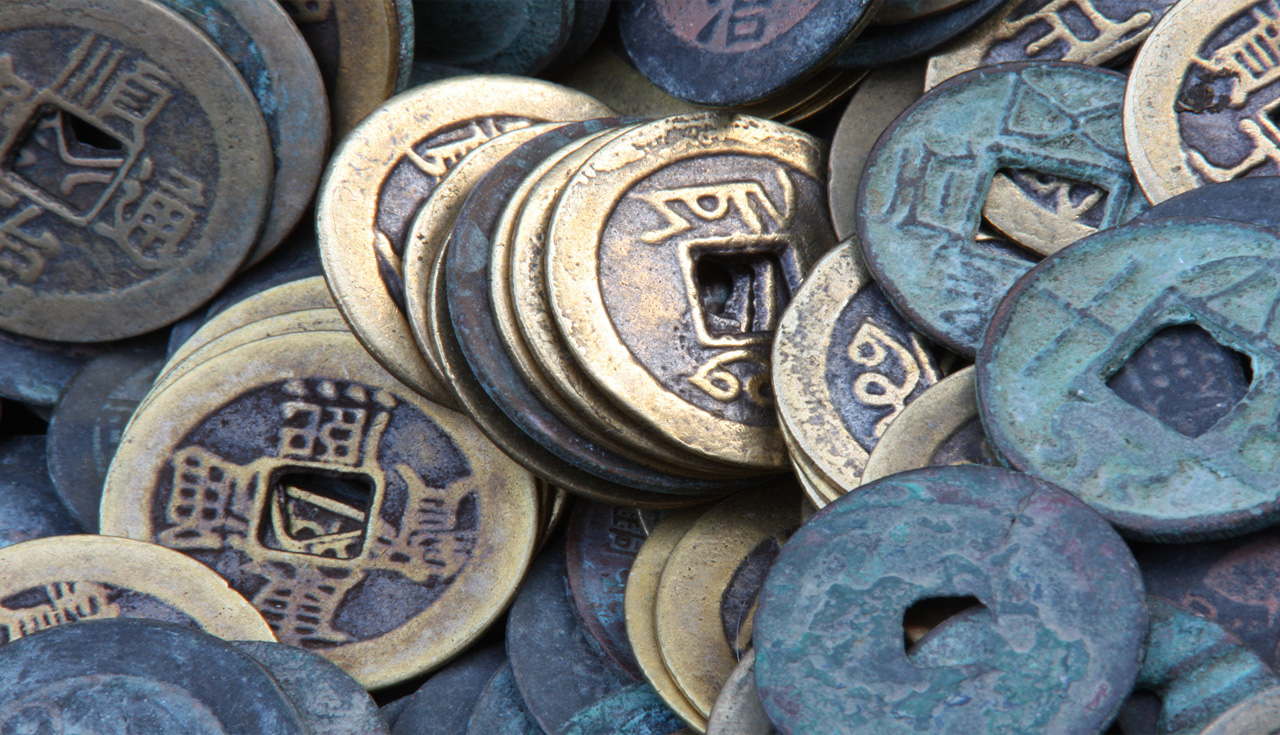
In ancient China, people first used cowry shells as currency, but around 200 BCE, Qin Dynasty Emperor Shihuangdi standardized money to help make trading easier. He introduced the ban liang, which had a standard weight in the form of a round disc with a square hole.
Chinese coins were made by casting, instead of the more common practice of hammering. A reverse image of the coin would be carved out of surfaces of stone or clay and liquid bronze or copper would be poured in to cast the coin. A square center hole was part of the coin design for a number of reasons.
First, the holes made it convenient to string the coins in sets of about 1000. Ok, but round holes would have served the same purpose. Why were the holes square? It was largely an aesthetic choice. The round coin symbolized heaven and the square hole, representing Earth, indicated the four cardinal directions.
In addition, these ancient coins typically did not have any portraits or images on the faces to give a preferred orientation. Instead, they usually had four characters arranged top to bottom and right to left. The square hole provides a reference for orientation and lines up nicely with the four characters.
[notepad]