
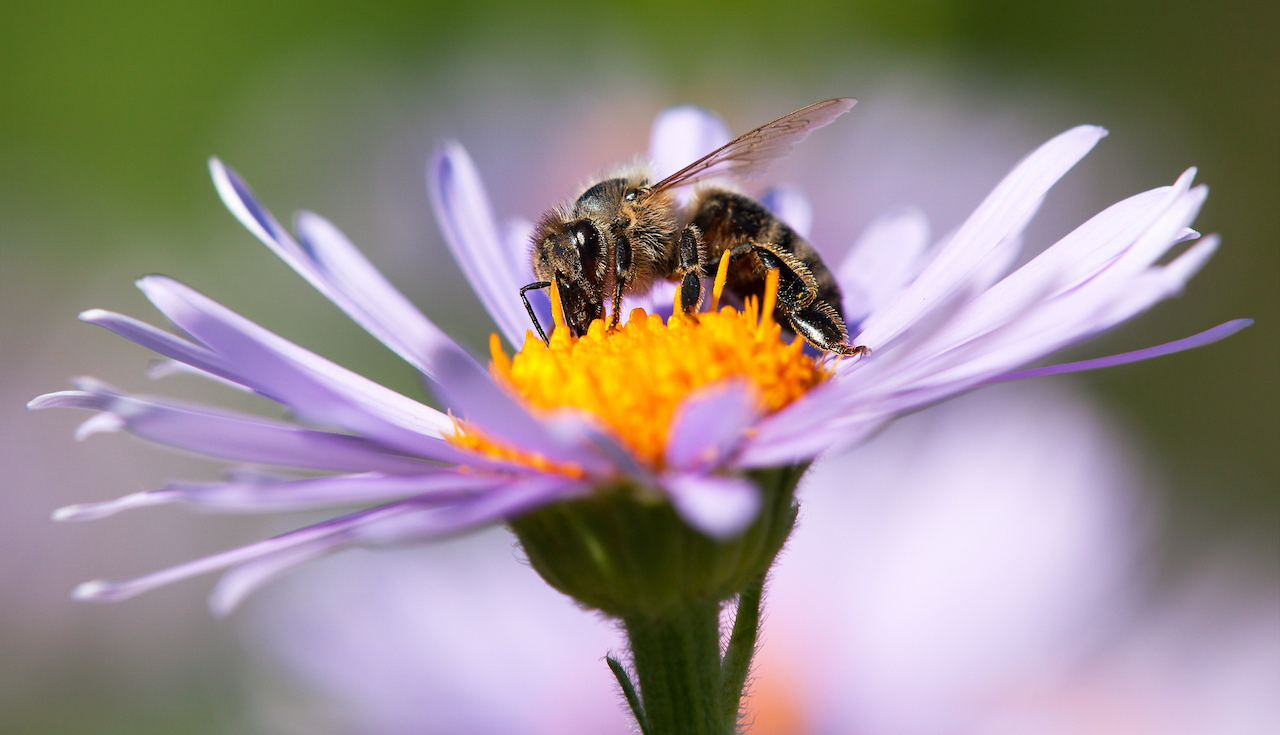
The Bee’s Knees
Bees have been having a rough go of things lately. Over the past couple decades, bee populations have been declining at an alarming rate. This affects all of us, and not just because honey for our tea might get more expensive. Bees and other insects pollinate 75% of the world’s crops. If there were no bees to do that, we wouldn’t have enough to eat.
There are many possible reasons for diminishing numbers of bees. The biggest of these is loss of both habitat and food sources. Increases in human population and the agriculture that goes with it means that there are fewer native plants where bees can get pollen, fewer places for them to build hives, and greater uses of pesticides.
But things might be looking up.
Amsterdam has seen an increase in bee species by 45% since 2000. How did the Dutch capital become such a haven for bees?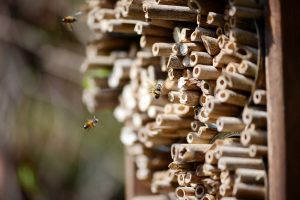 Through deliberate effort. Amsterdam has instituted policies of green roofs, increased planting of native flowers, and even bee hotels.
Many companies all over the world have begun to implement green roofs as a way to not only create more habitat for wildlife, but also to help control the climate within the structure and reduce reliance on heating and cooling systems.
Green roofs make sense, and more plants is an obvious answer, but bee hotels aren’t a real thing, are they?
Yes, bee hotels are a real thing. There’s no concierge to get you theater tickets, and it certainly doesn’t rate five stars. In fact, it doesn’t look like much more than a pile of sticks, or a block of wood with holes drilled into it.
But for solitary bees, this is the height of luxury. Solitary bees? Don’t bees live in hives, in colonies with a queen? Yes, many bees live the communal life, but not all. Some bee species spend their lives alone. Solitary bees don’t make honey, but they still visit flowers for their nectar, pollinating them along the way. Solitary bees look for holes like the ones in insect hotels for their nests, building a mud door over the entrance hole.
Amsterdam isn’t alone in their bee-friendly policies.The European Union banned neonicotinoids, a pesticide that is very harmful to bees, in 2018. An Irish company, ApisProtect, has devised an innovative technology to help beekeepers. A sensor unit attaches inside the hive to collect data, which then goes to an app so that the beekeeper can keep the hive healthy.
And then there’s Notre Dame. The world watched in horror as the roof and spire of the cathedral, one of France’s most iconic landmarks, burned in April 2019. One thing that many people didn’t realize was that three beehives had been installed on the roof in 2013 as part of the city’s drive to improve bee numbers. Happily, the hives survived and are still buzzing along.
Hopefully, the rest of the world’s bees will do the same.
Sources:
- https://www.bbc.com/news/world-europe-47995604
- https://www.theguardian.com/environment/2018/apr/27/eu-agrees-total-ban-on-bee-harming-pesticides
- https://www.apisprotect.com/home
- https://qz.com/1386616/amsterdams-insect-hotels-are-helping-to-save-the-citys-bees/
- https://www.nbcnews.com/news/world/bees-are-dying-alarming-rate-amsterdam-may-have-answer-n897856
[notepad]



The Bee’s Knees | Reflection
Junior Cycle Business Studies Specifications
- Strand one: Personal Finance
- Element: Exploring Business
- 1.9 Debate the ethical and sustainability issues that arise from their consumption of goods and services and evaluate how they can contribute to sustainable development through consumer behaviour
- Element: Exploring Business
- Strand two: Enterprise
- Element: Managing my resources
- 2.1 Identify different types of financial, cultural and social enterprise and appreciate the role each plays in society
- 2.2 Describe the skills and characteristics of being enterprising and appreciate the role of an entrepreneur in an organisation, in society and to the economy
- Element: Managing my resources
Curriculum Elements of the 8 Key Skills of the Junior Cycle
- MANAGING MYSELF
- Knowing myself
- Making considered decisions
- Setting and achieving personal goals
- MANAGING INFORMATION & THINKING
- Gathering, recording, organising and evaluating information and data
- Thinking creatively and critically
- Reflecting on and evaluating my learning
- Using digital technology to access, manage and share content
- BEING NUMERATE
- Estimating, predicting and calculating
- Developing a positive disposition towards investigating, reasoning and problem-solving
- Seeing patterns, trends and relationships
- BEING CREATIVE
- Imagining
- Exploring options and alternatives
- Implementing ideas and taking action
- Learning creatively
- Stimulating creativity using digital technology