

Raising Funds For Your Group
You may not have thought of your sports club as a business that has resources. Pretty much any organization is going to need to make at least occasional purchases. In order to do that, you need to have a budget. The expenses could be any number of things, from food to equipment to paying to use a pitch or a clubhouse.
None of that comes cheap, and you can’t ask your parents to cover costs all the time. So what do you do? Holding a fundraiser is a good way for your community to get involved in raising the funds you need. Think about what exactly you want to accomplish, and what kind of resources you have available to work with.
Here are a dozen great ideas to get you started.
Note: before you take on any fundraiser, make sure to check your local regulations. Having the right permits is just as important…
1. Sponsored challenges: Challenges can be anything you can think of, but the crazier they are, the more sponsors you usually get. A readathon, a 5K, a jump rope challenge. Say you’ll do something, and get multiple people to sponsor your efforts.
2. Match Day Raffle: Raffles are simple. Simply sell tickets for a donated item (or have a 50/50 raffle, where the winner gets half of the cash) and have the drawing at the end of the match. (Make sure you get any necessary permits first.)
3. Bag Packing: Turn up to your local supermarket (with advance permission!) sporting your club kit and spend an afternoon packing everyone’s shopping. Since this is a free will donation, be sure to turn on the smiles!
4. Family Fun Day: You can combine several smaller fundraisers here. Set up a car wash, host a lip sync battle, serve food, run an obstacle course, and of course face painting. A car boot sale is an additional way to not only raise money, but get rid of some of the stuff you don’t really need anymore. 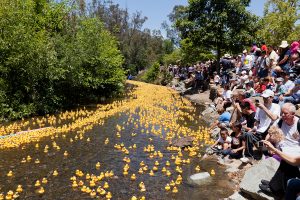
5. Duck Race: Rubber ducks racing down a river? Get your permit, number the ducks, sell the tickets, and off you go! Best of all, you can run more than one race per day, and if everyone buys a duck for €5, you’re laughing. Don’t forget to collect the ducks after each race.
6. Quiz Night: This takes a little set up, but is always popular. Six to ten rounds, with five to ten questions per round, will keep things interesting but not take forever. Fun prizes make things more appealing!
7. Busking/asking for donations: have a few volunteers hang out in busy locations and ask for donations. Musically inclined members can also get donations via busking (don’t forget the permit here).
8. Golf Classic: A golf classic is a golfing tournament over a few days. Teams can be friends or a mix of people put together when they arrive; either way, everyone has fun. Put an ad in the local paper and you’ll attract loads of people, and don’t forget the prizes!
9. Business sponsorship: many small (or large!) businesses like to help out local groups, especially when kids are involved. They can provide you with funds, or equipment, or services in exchange for some advertising.
10. Bake Sale: Set up a table at matches, where you sell donated deliciousness. Can also be combined with Club Cookbook, see below.
11. Club Cookbook: Everyone submits a favorite family recipe, which are then combined into a cookbook, which then gets printed and sold. A curry cook-off evening is a perfect match with this.
12. Skills Auction: All of us have skills that can be auctioned. From gardening to painting, computer knowledge to knitting skills; give up a couple of hours of your time to someone who could use the help. Parents can also offer to donate skills.
Of course, sometimes bringing in new members is the thing your club needs. If that’s the case, consider a “Buddy Night,” where a current member can bring a friend for a small fee. When the buddy sees how great the club is–new member! Also, if you’re looking for more interaction, be sure to have an up-to-date website. It doesn’t have to be fancy, but something with current information, a calendar of events, and some killer pictures will go a long way.
Don’t forget–sometimes setting up and running a fundraiser takes money to get started. Don’t get so caught up in the planning that you lose sight of why you’re doing this–to raise money for whatever goal you set. Keep track of everything, and make sure that what you spend isn’t more than what you bring in.
Sources:
- https://blog.pitchero.com/15-fantastic-fundraising-ideas-for-sports-clubs
- https://www.goraise.ie/blog/gaa-fundraising-ideas/
- https://www.mykidstime.com/school/50-clever-fundraising-ideas-schools-clubs/
[notepad]



Raising Funds For Your Group| Reflection
Junior Cycle Business Studies Specifications
- Strand 1: Personal Finance
- Element: Managing My Resources
- 1.5 Identify reasons for saving and borrowing money, relate the reasons to determining appropriate sources of finance with respect to their purpose, costs and risks
- Element: Managing My Resources
- Strand two: Enterprise
- Element: Managing my resources
- 2.2 Describe the skills and characteristics of being enterprising and appreciate the role of an entrepreneur in an organisation, in society and to the economy
- Element: Using Skills for Business
- 2.11 Assess the importance of planning an organisation’s cash flow, propose suitable sources of finance to manage expenditure and prepare a budget
- Element: Managing my resources
- Strand Three: Our Economy
- Element: Managing my resources
- 3.1 Explain how scarcity of economic resources results in individuals having to make choices; predict possible consequences of these choices
- Element: Managing my resources
Curriculum Elements of the 8 Key Skills of the Junior Cycle
- MANAGING MYSELF
- Knowing myself
- Making considered decisions
- Setting and achieving personal goals
- MANAGING INFORMATION & THINKING
- Gathering, recording, organising and evaluating information and data
- Thinking creatively and critically
- Reflecting on and evaluating my learning
- Using digital technology to access, manage and share content
- BEING NUMERATE
- Estimating, predicting and calculating
- Developing a positive disposition towards investigating, reasoning and problem-solving
- Seeing patterns, trends and relationships
- BEING CREATIVE
- Imagining
- Exploring options and alternatives
- Implementing ideas and taking action
- Learning creatively
- Stimulating creativity using digital technology